Remember when a Happy Hour meant you were assured of a nice snack, offered free, on-the-house, complimentary to compliment the purchase of your preferred cocktail? Not just a bowl of peanuts or pretzels, but some substantial menu items? I present to you my humble opinion of the greatest happy hour spread ever.
The Happy Hour was a modern day version of yesteryear’s “Free Lunch”- an age-old tradition, offered up at turn-of-the-century saloons, to draw in patrons, and keep them drinking. Usually some salty fare, to keep the imbiber imbibing. According to Wikipedia, the free lunch was especially a big deal here in San Francisco.
“Free Lunch” By Charles Dana Gibson
An article in the Chronicle stated in San Francisco during the 1890s, of 4,500 saloons and bars, almost all of them provided free lunches that ranged from “bologna, cheese, bread, steamed clams and chowder” at joints along the waterfront to “clam chowder, clam fritters, frijoles, ham, tongue, chopped beef, pigs’ feet, shrimp salad, chicken salad, sandwiches of all kinds, roast beef, roast mutton, baked salmon trout, strawberry shortcake, lemon pie, green onions, radishes, olives, celery, ginger snaps, wine crackers, Saratoga chips and apple and banana fritters” at upscale establishments on Market Street.
Well, back in the 70’s, as a dating teen, and trying to impress my then girlfriend, future wife, I chose to take her to a few spots around town that I considered impressive. Alfred’s Steakhouse, at it’s original location on Broadway, just next to the tunnel and near the Powell-Mason Cable Car line. Julius’ Castle perched high above the Embarcadero on the East slope of Telegraph Hill. The Shadows, right up the block on Montgomery St. with it’s tasty schnitzel and spatzen and another view of The Bay to die for.
They always sat us in that bay window near the bar
Money was, apparently, no object to Johnny GotRocks (18 year old me). Nothing but the best for my gal! (Notice my lack of mention of highbrow dining spots Ernie’s, The Blue Fox, The Mandarin, Fleur D’Lys…so I guess price did mean something…) But one weekend, I discovered this classy dark Italian/Continental spot hidden away on Commercial Street, an alley in the Financial District, and I made a reservation for dinner at Paoli’s.
The place was dark, with a long curved bar to the right of the entrance. The classic restaurant was originally at 347 Montgomery St at California since 1951. A little bit on that history:
Joe Paoli was a successful restaurateur, a beloved host, and a former light-heavyweight boxer for the Olympic Club, that had several opportunities to go pro, but he turned them down because, he said “he hadn’t the heart to hurt anyone.” Paoli’s was a destination for bankers and businessmen, politicians and celebrities, including famous boxers of the era when they visited San Francisco. On any given night you might find the likes of the great Jack Dempsey, Ring Magazine “Fighter of the Year” Carl “Bobo” Olsen, and undefeated World Heavyweight Champ Rocky Marciano.
In 1966, Paoli’s was evicted because the entire block was about to be demolished for construction of 555 California (the then Bank of America Tower). So the restaurant moved a few blocks over to reopen on New Year’s Eve on Commercial Street. And that’s the restaurant I visited on more than one occasion in the 70’s.
Back to date night: What a menu! Chock filled with Italian and Continental cuisine classics like Veal Scallopine with Fettuccine Alfredo, Petrale Sole Almondine, Steak Tartare and Abalone Steak (when you could still find it on a restaurant menu!) Check out this magnificent array of selections!
Fois Gras! Caviar by the Ounce! Escargots! Proscuitto and Melon! GTFO! Paoli’s was classier than diamond cufflinks. Something, of course, I never wore. And also four menu items that I wouldn’t think of ordering as a teen.
But while waiting at the bar for our table (yes, we got served actual adult booze-filled cocktails. It was San Francisco in the 1970’s, folks. Don’t judge. Although the ABC DID apparently do their jobs once in a while…)
“Sacrmaneto” always trying to spoil a young guy’s hot date night out. But I digress….
Sitting at that bar, sipping on a Bourbon Press, Jack and Coke, or some other mixed drink I had mentally locked and loaded to snap answer the bartender’s “whaddaya havin” query, I noticed a long groaning board set-up between the bar and dining areas. I ambled over to discover…THE GREATEST COMPLIMENTARY HAPPY HOUR BUFFET EVER!
To my memory, it seemed like that buffet had most of the items I would to order off Paoli’s menu. No caviar, smoked salmon, or oysters on the half shell (my 18 year old Neandarthal self said “thank you”). But platters and platters of delicious ravioli, chicken wings, pizza and foccacia, marinated calamari, deep fried zucchini, mini tacos, meatballs, deviled eggs, potato and three bean salads, marinated olives, artichokes, cold cuts, Liverwurst, multiple cheeses, different sliced breads and condiments to assemble sandwiches to your hearts content.
This article from 1979 backs up my claim:
After much intensive research, Chronicle Food Critic Ruthe Stein gives Paoli’s happy hour the highest accolade she can give it: the prized Four Pretzels.
Legendary, indeed. Unrivaled, agreed. And where in the hell does she get off quibbling about the calorie count at the free bar buffet? Hey Lady- try skipping the delicious (DID I MENTION ON-THE-HOUSE?) feast and go order a Limestone salad with a light vinaigrette off the goddamned menu. Jesus.
We sat and had a grand meal that night. But returned several times after just to enjoy Joe Paoli’s hospitality, the fine drinks being poured behind the bar, and of course, to grub on that great happy hour buffet.
Like many classic San Francisco institutions, Paoli’s finally closed their doors in 1982. Maybe one reason is that the Commercial Street location didn’t have the foot traffic that busy California and Montgomery Streets has. I’m not sure. But I know that I have fond memories of the newer restaurant.
Ultimately, 565 Commercial was converted into a Pacific Gas and Electric Substation (Substation J- and might I say it’s a pretty gorgeous facade?) Today, the former restaurant houses office space that include a small publisher, a law office, and an architectural firm. No happy hour buffet to be found.
It certainly was a different time in The City. Tell me where you can go these days, and for the price of a cocktail, eat like a king? I’ll leave you with a “recipe” (for life?) that Joe posted, maybe you can live “like a King- a la Paoli.”
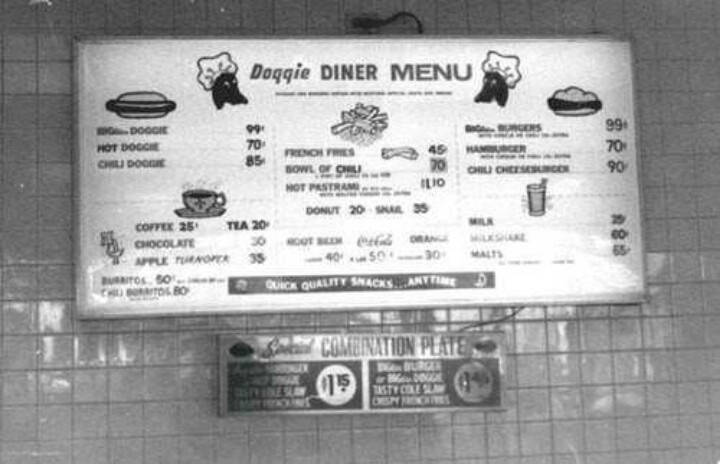
If you grew up in San Francisco, or anywhere in the Bay Area for that matter, you will remember the chain of hot dog stands notable for the massive bow-tie wearing, chef hat sporting dachshund head looming high above. This was the long-gone, beloved Doggie Diner.
Sloat at 46th Avenue, across from the Zoo
Doggie Diner was born in Oakland on San Pablo Avenue in 1948. Known for their delicious hot dogs (of course), they also had superb burgers, fries, shakes and pastrami sandwiches. By 1963, owner Al Ross had 15 locations- 12 in the East Bay and 3 in San Francisco.
It wasn’t difficult to spot a Doggie Diner location since each one had a giant rotating fiberglass dachshund head that stood outside each restaurant.
These three doggies are on display on a flatbed, usually parked on Treasure Island
From 1948 to 1986 they had a total of 30 locations. It seemed like every neighborhood in San Francisco was represented in the 1960s and 70s.
The Doggie in my old neighborhood, the Excelsior, was at 4701 Mission at Persia (where Yick’s Liquor relocated to and has been for years), but almost every area in The City was graced by that iconic dachshund with the chef’s toque perched on his canine head.
I specifically remember this location for it’s photo of Riordan High School classmate Terry Sturdevant, and San Francisco Giant Legend Willie McCovey after Terry won a hot dog eating contest as a grammar schooler. During the height of the restaurant chain’s popularity, McCovey, alongside other Bay Area sports legends like the Raiders’ Jim Otto, frequently served as a celebrity judge for Doggie Diner’s high-profile hot dog eating contests.
18th and Mission (Greg Gaar Photography)
Van Ness and Golden Gate (where Opera Plaza currently stands) Susan Ehemer/The Chronicle 1978
3rd Street at Townsend, across from the Southern Pacific Depot (notably Pac Bell/AT&T/Oracle Park is years away from existence, but the Lefty O’Doul Bridge is fully functional)
SP Depot, before it’s demolition and relocation a few blocks West in 1976. That DD lasted probably another 10 years.
Mission at Army St (Caesar Chavez) near the former Sears Building
Another shot on Mission, looking West up Army St (Bernalwood.com)
Geary at Arguello
The Doggie wasn’t beloved everywhere. In 1975, with strong NIMBY pressure from local merchants and residents, they were denied a permit to build at the corner of 19th and Irving (where a Starbucks currently resides).
In 1981, San Francisco powers-that-be passed a city ordinance outlawing rotating signs, and that was the beginning of the end for our dear doggie beacons.
When San Francisco hosted the Democratic National Convention in 1984, the Sunday combination Examiner/Chronicle posted this strange guide to visitors with a cop fetish that featured Doggie Diner prominently (giving not-so-glowing reviews on the cuisine. Hey, Jackass! It was a HOT DOG STAND! And, not to nitpick the snarky column, but “TJ Hooker” was set in a fictional L.A. city. Maybe “Streets of San Francisco” might have been a better choice…)
After years of serving up delicious hot dogs (no matter what that “hilarious” convention guide said) the DD couldn’t keep up with the hottest and fastest growing big chain fast food burger barns- McDonald’s and Burger King. The final final at 10th and Mission Streets (and one in Alameda) was shut down in May of 1986.
Doggie Diner super fan, car salesman Kip Atchley made a heroic effort to reincarnate the beloved hot dog stand in 2019. He had a partner, financial backers, but unfortunately, his dream never quite came to exist.
Kip Atchley
Last post on his Doggie Diner website was from June of 2022 and according to that post, it seems that Mr. Atchley had health issues that had him step away from his dream of opening a reproduction of the Diner. But his website remains: (click the DD logo to visit his page with archives)
He’s not the only super fan of Doggie Diner: here is another page dedicated to the memory of the delicious hot dog depot, the dachshund, and all things in between. https://doggiediner.com/
For those of us that loved Doggie Diner, maybe this Farley comic strip expresses how we all feel…
Well, well, well…you’ve all been clamoring for it! And here it is! The “long-awaited” (jk) finale to the three-part epic tour of San Francisco’s (and North Beach’s) Broadway with Dick Boyd, one-time saloonkeeper (bar owner) as he shares his memories of the late 50’s-early 60’s on The City’s bawdy Broadway.
Dick drops knowledge about Finnochio’s, Enrico’s, El Matador, Vanessi’s, the Off Broadway (yes, later Plaka Taverna- check out that post), and we end up at The Beat Museum (currently closed for retrofitting).
(Look, if you happened to watch parts one and /or two, you might as well finish the series. Are you gonna watch “Batman Begins” and “The Dark Knight” and not watch “The Dark Knight Rises”? Come on now…)
North Beach, San Francisco, CA July 1973 (Wikipedia)
Broadway. Once the epicenter of adult entertainment in San Francisco (well, at least in the early 60’s through the 1980’s) where today you’ll find most of the nightclubs, bars and restaurants boarded up, closed, or just a weak memory to that lively, loud, neon-lit heyday.
At the bustling corner of Columbus and Broadway still stands the “World Famous” Condor Club. Or should I say “infamous”. According to the brass plaque affixed to the brick facade, The Condor was “Where it all began” as the birthplace of topless (and bottomless) entertainment.
On June 19, 1964, soon-to-be legend Carol Doda would make history by donning a topless monokini, descending from the ceiling on top of a white baby grand piano, and shook her then un-ample breasts to a groovy rock tune for an appreciative horny audience. Instant big hit, to be copied by clubs up and down Broadway, and around the country.
Carol atop the piano (Gordon Peters, Chronicle 1964)
Carol underwent silicone breast enlargements (one of the first to do so- from a 34B to 44DD!), insured them for 1.5 million with Lloyd’s of London, suffered multiple indecency arrests by SFPD’s Vice Squad (and was cleared of all charges), gained lots of press for herself and the club nationally and internationally.
But who remembers maybe the most bizarre episode ever to hit Broadway? The time in 1983 that James Ferrozzo, known around North Beach as Jimmy the Beard, bruising Condor assistant manager, was found dead, stuck between the ceiling and the white baby grand piano that lowered and rose from the ceiling. The very same one that Carol debuted her topless routine 20 years earlier.
And pinned underneath The Beard, alive, fully naked, and truly freaked out, was 23 year old Mitchell Brothers Theater performer Theresa Hill.
According to the Examiner, the marquee promises of “Live Sex Acts” on stage were apparently in full effect after-hours as Jimmy and his girlfriend Theresa reclined on top of the piano. It’s possible that Jimmy accidentally kicked the switch that operated the piano lift (which crawler very slowly upward) and, distracted as the couple might have been, it was too late by the time Jimmy’s 240 pounds, and Theresa’s 110, got sandwiched between the baby grand and the ceiling.
Factualities, Louis R. Biro, 2011
They were discovered around 7am when a janitor had to bust a door down, saw Jimmy’s big leg stocking out from the ceiling. Theresa was, to put it mildly, somewhat distraught. (She was panicked!) They didn’t free her for another 3 full hours!
The coroner said the big man died of asphyxiation. The SFPD Homicide Inspectors said “it looks accidental…” but declared that the club was a mess, looking like a brawl had taken place earlier in the evening. No one ever found out if foul play was involved. But…it was Broadway in the 80’s. Who knows how hard they tried to investigate. Jimmy was beloved by many, “a good guy”, “real cool”, “the girls liked him”. But it was said that Theresa was escaping some violent past, some legal issues. And Jimmy was considered a brawler. So your guess is as good as mine.
But this one has to go down as one of the strangest deaths in The City, a place with a history of a lot of odd deaths.
Growing up in San Francisco in the 60’s, 70’s and on, the music scene was pretty epic. Everyone remembers the Winterland Ballroom and the Fillmore as they hosted the greatest rock acts of the era. But to me, for the most eclectic, varied, entertainment option in town, we headed to Bush Street to a small live theater venue called The Boarding House.
The Boarding House at 960 Bush Street, on Lower Nob Hill, was known by many names since it opened as a theater after the 1906 earthquake and fire, most recently Doug Weston’s Troubadour North (a sister to its famous Sunset Strip sibling in West Hollywood).
But in March 1971, David Allen who ran the hungry i for Enrico Banducci, and helped launch the careers of Barbra Streisand and Lenny Bruce, opened this amazing showcase for upcoming music and comedy acts
David hosted the most varied array of musical genres possible. Bette Midler, Billy Joel, Crystal Gayle, Harry Chapin, Neil Young, Waylon Jennings, The Dire Straits, Randy Newman, Jim Croce and many many more played the small concert hall on Bush. With less than 300 seats, there was no other performance venue more intimate than the Boarding House.
In 1975 Melissa Manchester had an up-and-coming stand up open for her: BILL “Billy” Crystal
In 1975, David brought in an act that would become world famous: Bob Marley and the Wailers, with a performance that music critic Joel Selvin dubbed “strange”.
Surreal Marley
We had the pleasure of sitting at a front row table during Steve Martin’s hilarious “Wild and Crazy Guy” performance. He recorded his first three comedy albums at the club.
Great banjo, plus we got the “Arrow through the head” gag up close and personal!
And we also got the thrill of catching young Dolly Parton…with her spectacular acoustic guitar work (with her impeccably long manicured fingernails) and oh that voice!
Richard McCaffrey/Getty Images
…and, the week previous, we caught the smooth cowboy classic Western harmonies of the great Sons of the Pioneers.
The Boarding House had a small restaurant in the basement run by local burlesque performer Magnolia Thunderpussy. The signature dessert was the “Montana Banana”- her erotic version of the banana split- this banana UNsplit, two scoops of ice cream, dollop of whipped cream. You get the picture…oh, there’s the menu….
So many live albums were recorded at the BH… here are just a few:
The Boarding House fell on hard financial times, so a star-studded concert was held at Civic Auditorium
…I do BELIEVE that last performer is ROBIN Williams, who launched his career at The Boarding House
But in 1980, there was a fire, and a developer was buying up property to build condos on that 900 block of Bush. The Boarding House closed in July of that year. They reopened in North Beach, but that club closed in ’82, David passed in ’84. The memories of one of San Francisco’s greatest entertainment clubs is all that remains.
San Francisco is a town that was built on bars. Saloons popped up almost as soon as settlers arrived, and a few of the originals (very few) have actually survived the constant change of our ever-changing city. The Saloon, The Old Ship Saloon, The Little Shamrock, Elixir, Vesuvio Cafe, Molloy’s in Colma and a few others are still standing (in one form or another), serving libations to lucky, thirsty patrons.
The poster above is proudly hung on the wall at Ray’s Hearth in the Richmond, and if you take a close look (click on the image to make it larger), you will notice how few of these drinking establishments are still in existence. Here is a (very personal) list of some of my favorite bars that ain’t around no more.
The Gold Dust Lounge
formerly at 247 Powell Street, near Geary, Union Square
This downtown classic was as much a Union Square mainstay as the cable cars that ran outside on Powell Street. Locals and tourists alike loved the friendly, funky vibe in the Gold Dust. The best prices on Irish Coffees, Margaritas and Champagne anywhere! Open at 6 am, it was a hangout for working class and business types. And they offered live music 7 nights a week. Over the years, visitors like Tony Bennett, Janis Joplin (owner Jimmy Bovis almost didn’t serve her!) and legendary columnist Herb Caen (who had his own stool) dropped in to join the fun. Powell Street hasn’t been the same since they were forced to shut the doors after nearly 47 years in existence. Change, for change’s sake.
The good news? Sadly, none. The Fisherman’s Wharf experiment was a failure- not enough locals, nor interested tourists. The bar was much bigger and a re-creation of Powell that IMO didn’t quite click.
Plaka Taverna
formerly at 1024 Kearny, near Broadway, North Beach
There was the Greek Taverna on Columbus, and then there was Plaka. The joint was loud and boisterous, the air filled with the sounds of classic Greek bouzouki music. As teens, we went to Plaka, with the owner’s daughter, Georgette. Sure, we were underage, but it was a different day, and Hey Natives! When did YOU first drink at a bar back in the day? Uh-huh. Anyways…we’d get a bit of liquid courage working, in the form of glasses of Ouzo, and we’d join the dancers circling the floor, having no idea what in the hell we were doing. But you jumped in the line, held hands and tried to follow the lead of the guy with the handkerchief in the traditional Kalamatiano dance. Then it was time for the amazing feats of wonder as a man lifted a fully-loaded table with his teeth and danced around the floor! And a few times, with a woman on the table!! Insanity! How did you show appreciation? By winging plates on the floor, or breaking full stacks of dishes, of course! The photo below is the late John “Papou” Stewart (Studianis), my daughter’s Grandfather-in-Law, in action! Plaka Taverna owner Gus Derdevanis held court over the wildest nightclub in North Beach. Nothing like it this side of Athens.
The good news? None. The location is just another available office space. And there are no old-style, plate breaking Greek spots in the Bay Area (that I know of), much less in North Beach.
Jay’N Bee Club
2736- 20th Street at York, Mission District
The Jay’N Bee was a noisy neighborhood bar, and one of our regular lunch stops when I was a young moving man working for Bekins Van & Storage, out of the warehouse only a few blocks away at 20th and Alabama. The place was packed with lots of SFPD, with workers from the Mission District factories, and yes, with furniture movers, all sitting inside or on the patio, grubbing on the great Merchant’s Lunch. For a reasonable price, you got a multi-course Family-Style spread that included a complimentary bottle of vino- red or white- served in a Calistoga bottle! And yes, besides the wine, they poured a nice stiff drink at the bar.
The good news? None. The Jay n’ Bee is just a memory in the hipster Mission of today. Head down to Pop’s on 24th, I guess.
Gene’s
formerly 5160 Mission Street, near Geneva, Outer Mission/Crocker Amazon
I grew up in the Excelsior District. My brothers and sister and I went to grammar school with all of the Balma kids at the now-defunct Corpus Christi Grammar School. Their dad, Gene Balma, ran the only bar I remember seeing my mother frequent regularly. Was Mom fond of the booze? Quite the contrary. Mrs. Cruz was as close to being a teetotaler as you would ever meet. But she went to Gene’s almost every week. For one reason: Gene made The. Best. Roast. Beef. Sandwich. Ever. Seriously. We would park in the lot behind the Bank of America, use the back entrance of the bar, and Mom would have us sit patiently, among the incredible collection of figural liquor bottles that Gene had displayed, while he would cut fresh Sourdough hard rolls, dip them in his secret ingredient au jus, and pile on the thinly-shaved beef. Wrapped in wax paper, we almost couldn’t wait to get them home! Miss you, Mr. Balma! And those sandwiches…
The good news? None. It’s currently the office for a Pentecostal church.
Bernal Heights was my hood for a short time, and as anyone familiar with the neighborhood knows, Cortland Avenue is the heart of Bernal. There were two bars up on the Hill: Wild Side West, an LGBT-friendly hangout on the South side of the street (still there and a great bar!), and Skip’s Tavern, on the other side. A Niner bar. A Giants bar. A working class bar. Period. To describe Skip’s as “untrendy” would be an understatement. But it was a cool live music venue. Bands played original Jazz, Rock and Blues sets 7 nights a week. I loved walking over from our house on the East slope, sitting at the big horseshoe-shaped bar, sucking down a cold one or three, and listening to the night’s jam session. Unfortunately, some ASCAP lawyers sued the owner, Bill, for copyright infringement, and he pulled the plug. “Too much trouble.” A another unique dive bar bit the dust.
The good news? Skip’s has been resurrected as The Lucky Horseshoe, and they have live music, so that’s a good thing. http://www.luckyhorseshoebar.com
The Peer Inn
formerly at Pier 33, The Embarcadero look
When I worked at KMEL in the late ’80’s, early 90’s, the morning show would gather to do our next-day show preparation at one place: a waterfront bar near the station called The Peer Inn. The Papadakis Family- George, Annie and son Gus- hosted you for a really nice lunch, liquid and otherwise. The Greek chef would occasionally yell “Skata!” at you through the open pass-through from the kitchen. Eddie and Babe, two Teamster forklift operators that worked on Pier 33, would come in for a bracer or three. Annie would eventually put out sweaty slices of salami and cheese as appetizers (yes, we’d eat them all), and bartenders Siobhan and Ava would pour nice stiff Embarcadero-worthy drinks. The bar dice would come out and it was noisy, dice cup slamming hours of Liars Dice, playing for dollars and rounds of drinks and bragging rites. And, sure, we even got a little show prep done.
The good news? It WAS a kinda-sorta restaurant catering to the Alcatraz ferry crowd. But that’s permanently closed. So no drunken forklift-operating Teamsters OR hungry tourists.
Bouncers
formerly at 64 Townsend Street at Colin P. Kelly (a WW2 hero), in what is now known as South Beach
Before there was an AT&T Park, and before there was the growth of high-rise high-rent apartments and the tony restaurants and drinking establishments that have popped up in the area, the Southeast end of the city was deeming with warehouses and trucks and industry that fed off the bustling port. San Francisco was the Maritime City and South Beach was filled with bars that cared to working-class longshoremen, Merchant Marines, stevedores and Teamsters that worked the ships and warehouses. I was a lumper (read: hired work horse) for a restaurant supply company and my driver (who was intimately familiar with every bar from North Beach to Dogpatch) introduced me to Bouncers. The walls were covered in souvenirs from all corners of the globe. Behind the bar was a framed poster of Daisy Duck, posed in a classic saloon-style reclining nude pose. I had an Oly for my coffee break, and ate some of the best salmon jerky made by a sailor who was three- no, check that- easily five sheets to the wind. Unforgettable.
The good news? None. More empty office space that a greedy property owner is ready to cash in on. Daisy would be ashamed.
Reclining Nude Daisy hung over the bar
Hoffman’s Grill
formerly at 619 Market Street at 2nd, Downtown/Financial District
This was one of the many great hofbraus in The City (of which only two- Lefty O’Doul’s and Tommy’s Joynt remain). But Hoffman’s Grill was much more. The look of the place was Old San Francisco, with it’s tiled floors, brass lamps, stained glass, and an Old-World vibe that is hard to fake. The owner, who sometimes worked the bar, was from Bavaria, and it was a kick chatting with him and listening to the German accent. One visit, he brought out the best bar snack ever: oysters on a half shell! (Not sure if that was a regular thing, but it was memorable) Hoffman’s served good cold draft beer in those big round bottomed chalice-shaped glasses (like the giant neon one on top of the Hamm’s Brewery). And tiny bottles of the German digestif Underburg hung from the back bar, ready to settle your upset stomach. This brick-front classic was destroyed in the 1906 quake, rebuilt, and sadly, was closed in the mid-80’s to allow an office building to be built around it. The building exterior has landmark status, but that doesn’t bring back the turn-of-the-century feel inside a once-great saloon.
The good news? It depends. The brick facade is still there. It WAS an outlet of San Francisco’s oldest bakery (and their cafe), Boudin. Then a part of the Buckhorn Grill chain. It’s nothing now. Just great. smh
Earthquake McGoon’s
formerly 630 Clay Street near Kearny, Financial District
Turk Murphy. Do you know the name? Well, music fans, Turk was the Greatest San Francisco Jazz Trombonist of All Time. Now, I’ll be honest, I don’t know of a lot of other trombonists besides Glenn Miller and Tommy Dorsey and New Orleans’s own Trombone Shorty, and I’ve never seen any of them. But back in the day, we had the giddy honor of watching, and listening to, and dancing to the great Turk Murphy and his Jazz Band at his club on Clay Street, Earthquake McGoon’s. It was such an outstanding nightclub, with was seating upstairs along a rail that overlooked the dance floor. Turk’s band rollicking with the loud, happy sound of Dixieland Jazz up on the stage. Dancing, boozing, happiness. And as a bonus, downstairs was the Magic Cellar, where pro magicians dazzled you. I’m not a big “Magic” fan, and saw one of the best mind-reading tricks ever. Pisses me off, it was so good. Earthquake McGoon’s eventually moved to Pier 39 but that didn’t have the syncopation of the dancehall on Clay Street with the magic cellar.
The good news? None. It’s a part of some monstrosity built at Montgomery and Clay. F off.
Lost Weekend
formerly 1940 Taraval Street between 29th and 30th Avenues, The Sunset
There will always be a place in my heart for the Sunset District, the place where some of my favorite people were raised (my wife being one of them). And it’s also the former home to one of the most laugh-provoking pubs that I ever spent a dollar in: a place called The Lost Weekend. When you walked in the door, past that glass brick front, the first thing you noticed was what, at first glance, seemed to be a piano. Okay, it’s a piano bar, right? Wrong. That’s an ORGAN, and Lost Weekend was the best Organ Bar I’ve ever seen. The organist could play everything, with a playlist that was heavily laden with Standards, but he would not let a then-current Rock song stop his flow. And there was one particular Regular, an older lady, who probably had Opera training in her past, that would hit notes that shook the glassware. Lost Weekend offered good booze, live music like no other, a hang with the fine Sunset Natives, and the funniest night out ever. I miss hearing “White Room” on a Wurlitzer. But, maybe that’s just me.
The good news? It is currently O’Brien’sIrish Pub, a nice, friendly local’s hangout with good food and live music (but no organ sing-a-long. And that’s okay.) https://obriensirishpubsf.com/
Enrico’s
formerly at 504 Broadway at Kearny, North Beach
Enrico Banducci was the father of the hippest trip in all of The City: the coffee house and bar that had his name above the sidewalk seating on Broadway, Enrico’s. He was like a Beatnik Cher. One name was enough to ID the beret-wearing barman. He founded another San Francisco legend, the hungry i on Jackson (where Enrico brought in up-and-coming talent like Woody Allen, Barbra Streisand, Bob Newhart, Lenny Bruce), and then decided to open The City’s first ever sidewalk cafe. A place so cool it was featured in one scene of, arguably, the coolest San Francisco movie ever, with the coolest star: “Bullitt” with Steve McQueen. We used to snag a table, and try to look cool. and spend an evening watching the parade pass by. The parade ain’t what it used to be.
The good news? None. Like Steve McQueen, only cool memories remain. It’s a sad empty hulk, a ghost of its hip heyday. Shit.
Breen’s formerly at 71 Third Street at Market, South of the Slot (SoMa, for the uninitiated)
Third Street was always Skid Row when I was growing up. But closer to Market were a couple of classic San Francisco saloons, hangouts for Newspaper men (specifically Examiner staff, due to the proximity of the Hearst Building, up on the corner. The Chronicle crew went the M & M Tavern on 5th and Howard- a whole ‘other story) One was Jerry & Johnny’s. The other? Breen’s, which had the most beautiful back bar. Big long bar, maybe the longest I’ve ever seen. The photo below doesn’t do it justice. Breen’s was also a decent Hofbrau. The bartenders and waiters wore white coats and ties. And they served Anchor Beer on tap, which was kind of a rarity, at least at bars I usually visited, which leaned towards Bud and Lucky Lager. But that bar. When Breen’s closed I believe that Henry Africa (Remember him? Of Fern Bar fame?) bought it. But I’m not sure where it eventually landed. Ripping that bar out is like ripping someone’s heart out. Another classic, replaced by….
The good news? None. It’s unrecognizable and the original building is gone, replaced by a monolithic extension of UC Berkeley.
Welp, I gotta be honest, a revisit of this post kinda bummed me out. Gotta head over to Spec’s and grab a beer and a cracker and cheese basket…
Everyone has their food touchstones from growing up wherever they grew up. It might be something as simple as Hostess Sno-Balls that mom put in their lunch or a chocolatey Yoo-Hoo that they spent allowance on at the corner store. A friend from New York waxes eloquent about bagels, and makes the argument that “no where on earth can you find a bagel the likes of a New York City bagel.” Texans brag about their barbecue. You should hear the arguments over their German-influenced sausage. I mean, Elgin vs. Lockhart? It’s a war, y’all! It seems everyone gets downright defensive over their hometown pizza. And growing up in San Francisco, there are foods that bring back memories (and add the pounds, when I don’t check myself, which, if you know me, I most don’t.). Here are a few of the iconic foods that beckoned me home, to savor the flavor, and to pack on the LBS.
Focaccia from Liguria Bakery 1700 Stockton St. at Filbert, North Beach
If you’ve ever seen a long line of people standing outside this little bakery at holiday time, know that they’re waiting for the best focaccia ever made. Liguria Bakery is one of the oldest businesses in North Beach. The Soracco Family has been making basically one item for generations. They have several versions- plain, garlic, rosemary, raisin, all of them delicious. But the best? Go in, ask them to cut up a pizza. They’ll put the oily, tomato-y, onion-y, caramelized-edged slices of heaven on a sheet of waxed paper, and into a paper bag for you. I defy you to get home without having a piece or two.
Pan Sautéed Sand Dabs from Tadich Grill
240 California St between Front and Battery, Financial District
The sign on the window says that Tadich Grill is the “The Original Cold Day Restaurant”. Not exactly sure what that means, but despite the weather, any day is a good day to eat at this San Francisco classic if you’re in search of tasty seafood selections. My favorite is a not-as-well-known tiny little flatfish called a sand dab. Silly name, delectable dish. Mildly flavored, accented with simple seasonings (salt, pepper, dust of flour) sautéed and served up fresh. You can have your tilapia and ahi. Sand dabs at Tadich? Perfection! even on a hot day.
Cheeseburger on French from Original Joe’s
601 Union Street at Stockton, North Beach
11 Glenwood Ave, Daly City
We constantly get bombarded with “Best Burger” lists. But the one constant omission is my favorite- a perfectly char-broiled ground chuck burger laced with diced onions, topped with swiss cheese or provolone, on a Sourdough roll grilled in garlic butter. Let me quote George “Mr. Sulu” Takai- “Oh my!” You don’t need extras or condiments, it’s just that good! Whether were at Original Joe’s- North Beach or San Jose, Marin Joe’s, the old Joe’s of Westlake or even Val’s in Daly City- a Joe’s cheeseburger makes the top of my “Best Burger” list everytime!
Italian Dry Salami from Molinari
373 Columbus Avenue at Vallejo, North Beach
Fun Fact: Most people outside of San Francisco and the Bay Area have little idea about the delicious cured meat known as Italian Dry Salami. Try ordering a salami sandwich elsewhere and you’ll get Genoa-style (larger grind and fattier), Cotto (softer, less cured), Kosher (very Baloney-esque in my opinion), even “salami” that is more like Summer Sausage (think Hillshire Farms). OUR Italian Dry Salami is best represented by Molinari. Custom spiced pork, jammed into natural casings, is then dry cured for around 4 weeks. A white mold forms on the casing during this process. (Each salami gets hairier than Tom Selleck’s chest! You don’t want to see them during this phase.) I know that sounds nasty, but that mold what makes our salami the tastiest! Spicy, salty, amazing. We have sent Molinari salami to friends around the country, and they beg for more. Uniquely delicious.
Joe’s Special from Original Joe’s (actually ALL the OJ’s have this dish!)
301 S 1st St, San Jose
A simple dish that is simply mouthwatering tasty, legend (arguably) has it that the Joe’s Special was invented at the long-gone New’s Joe’s on Columbus when hungry Prohibition-era Jazz-men wanted a filling dish after jamming at Barbary Coast nightclubs. Ground chuck, onion, spinach and eggs in a taste-tempting scramble of delight! Whether late-night or for breakfast, a Joe’s Special works any time of day. Original Joe’s in downtown San Jose, has been serving a perfect version of this dish since the 50’s. A Joe’s Special gives the word “special” a savory meaning.
Dungeness Crab Sandwich from Nick’s Rockaway
100 Rockaway Beach Avenue at Highway 1, Pacifica
I know this one is out of The City, but it’s definitely worth the drive down Highway 1 to Pacifica for the best Dungeness crab sandwich served anywhere. Period. Sliced, butter-grilled sourdough (again!) piled with a heaping helping of lump Dungeness crab meat, just moistened with mayo. The sandwich is not cheap, but it’s absolutely worth the price. Have you ever ordered a crab sandwich and been disappointed with how little crab is in it? I assure you, Nick’s does not skimp. You will not be disappointed.
Sourdough Bread from Boudin Bakery
399 10th Avenue at Geary, Inner Richmond
Sourdough French bread is as San Francisco as the Golden Gate Bridge, Cable Cars and Liberal politics. French bakers brought their techniques here during the Gold Rush and the best versions of these deliciosly sour loaves have been made here ever since. Remember Parisian? Larrabaru? Toscana? Venetian? All gone. Thankfully, the earliest Sourdough bakery is still alive and thrives. Boudin started in the original settlement and moved to it’s current location in the Richmond after the 1906 Quake and Fire, and the “mother dough” starter went with them. No respectable restaurant in The City does not start your meal off without a basket of fresh, delicious Sourdough. The best thing to ever come out of France (Catherine Deneuve excepted.) Viva le pain de Boudin!
Carnitas Super Burrito from Gordo’s Taqueria
2252 Clement Street at 24th Avenue, Outer Richmond (and other locations)
There is no style of burrito better than the Over-Stuffed Tortilla Bomb of Goodness invented in our own Mission District. A multi-pound meal in itself, a Super Burrito is a large tortilla stuffed with meat, cheese, salsa, rice, beans, and more. Ay Dios mio! People spend hours arguing the merits of Mission burritos on a daily basis. La Taqueria (delicious) vs. El Farolito (equally as delicious). La Cumbre (delicious) at 16th and Valencia claims to have invented it in 1969. An odd claim, since I remember my first Super Burrito at El Faro at 20th and Folsom before then. But who gives a s**t? I’m just glad it was invented. And (here comes my shocking choice) the best version of a Carnitas Super Burrito is not found in the Mission. Head West to the Richmond and make a stop on Clement to get the primo SB at Gordo. Their carnitas is the most delectable. Their pico de gallo and hot green salsa- untouchable. Sure, you can scour the Mission and find delicious SB everywhere. Or venture out West and get the mostest deliciousest of all! [and 3, 2, 1…commence cursing me]
Hangtown Fry from John’s Grill
63 Ellis Street at Powell, Downtown/Union Square
Do you know about the Hangtown Fry? This is a dish with a bit of mythic history behind it, one story claiming that it was created during the Gold Rush at a hotel restaurant in Placerville (a.k.a Hangtown) when a prospector hit the Mother Lode and, big shotting it, demanded the most expensive dish that the kitchen could make. So the chef combined eggs (a prized perishable), bacon (from the East Coast) and oysters (transported, on ice, from the Bay). Tadich has had an excellent version on it’s menu for over a century and a half. But I like the one served at John’s Grill (made famous in “The Maltese Falcon”). A scrumptious omelette with fried oysters and bacon. Nothing like a classic dish prepared in a classic style at a classic San Francisco institution. If it was good enough for Sam Spade, it’s good enough for me.
Al Pastor Tacos from El Tonayense
Trucks along Harrison Street, Mission District
As far as taco fillings are concerned, I’m not especially picky. Carnitas, Carne Asada, chicken, Baja-style fish, all good in my book. Okay, I’m not a big fan of sesos (brains), tripas (intestines) or buche (fried pork stomach). Hey, I’m not Andrew Zimmern, so Bizarre Foods aren’t always my thing! But my favorite taco filling of all is Al Pastor. Marinated pork, roasted on a spit, then carved so that each morsel has spice and caramelization, is the tastiest of the tasty! The best version I ever had is at a small taco shack in Tijuana, just over the border, near the cab stands. Small, quickly fried corn tortillas filled with Al Pastor and a great guacamole. Simple, and crazy good! And the next best thing when I’m not in Mexico are the Al Pastor tacos on the El Tonayense trucks that can be found on Harrison Street in The Mission. There’s one near Best Buy, more scattered towards Bernal Heights. Get 2, or 3, or more. So very good!
Lazy Man’s Cioppino from Scoma’s
Al Scoma Way, off Jefferson Street, Fisherman’s Wharf
Whenever we went to Fisherman’s Wharf, my parents would walk us down the pier at Jefferson and Taylor, past the fishing boats, and take us to dinner at “the local’s favorite”, Scoma’s. The Scoma Family has been hosting San Franciscans and visitors to The City since the 60’s. And with the extensive list of seafood dishes on their menu, another San Francisco classic stands out: Cioppino. Created by the Italian fishermen from North Beach, Cioppino is a spicy, tomato and wine based fish stew, filled with shrimp, clams, Dungeness crab legs, scallops, and cod. And for messy bastahds like me, Scoma’s is a “lazy man’s” version, everything is pre-cracked or shelled. A big bowl of cioppino, a glass of vino and some Sourdough- my mouth is watering as I type.
Prime Rib at the House of Prime Rib
1906 Van Ness between Washington and Jackson, Russian Hill
Meat Eaters, rejoice! This beautiful, club atmosphered temple of beef has been dispensing delicious cuts of hand-carved prime rib roast since 1949. They have a (not extensive) menu (it has a few other offerings), but the reason to come here is on the name above the door. Prime rib. The carver wheels a large silver-domed cart to your table (what I call “The Rolling Casket of Beef), opens the top, unveiling roast beefs and asking what cut you prefer. Here is the most amazing aspect of a prime rib dinner at HoPR: they will serve you seconds if you ask them! What?! It’s true. If you want another cut of beef once you’ve finished your first serving, they’ll gladly carve it for you. Prime rib done in prime fashion. If you haven’t been there (or you’re leaning towards a Vegan diet) don’t miss it! And good luck scoring a reservation these days…
The same way that most people growing up these days have had that ever present burger, born under an arch of gold, “billions sold worldwide”, in most of their lives, a local San Francisco take-out hamburger stand was a part of my life as long as I can remember. That would be the small, extremely local chain called Tic Tock Drive In.
Tic Tock Drive Ins were our McDonald’s a long time before that clown Ronald made his way to The City in the early 70’s. Tic Tock #1 opened on July 20 1953
It wasn’t the first drive-in restaurant in San Francisco. Mel’s was first, opening their original location at South Van Ness and Mission (the “American Graffiti” movie location) in 1947. But for me, there was a Tic Tock right down the block from my house on Ocean and Alemany (at Cayuga) in the Excelsior. But Tic Tock distinguished itself as the “first of its kind self-service drive-in type of operation”. What’s that mean? Get out of your car, walk up to the window and tell them what you want. No carhop is skating up to take your order.
The Original, Tic Tock #1, Ocean and Alemany
My Tic Tock, the first of five, was located at Ocean and Alemany. It opened in July 1953, when two San Franciscans, both Galileo High alumni, a Korean War vet and his Merchant Marine partner decided to start up what was becoming a hot business trend, following the lead of those two McDonald brothers from San Bernardino.
The big revelation? “Self-Service Type”. It’s not like you assembled your own cheeseburger. But no waiter or waitress was bringing it out to you. Like today, you went to the counter, ordered, and picked up your bag of food to-go. Wow. The future is here!
I distinctly remember their deals: a bag of five burgers for (in 1968) a buck and a quarter. But checking out their ads from the 1950’s really makes you long for the past
Of course that 89 cent chicken deal, adjusting for inflation, would be around $11 today. Still, Chef Tic Tock was offering a pretty good bargain any way you look at it. And, along with newspaper ads plugging the latest meal deals, Tic Tock management made sure to hype any and all minutia about their fantastic food.
You’ll notice the ads highlight four Tic Tock locations: North Beach, Bayview, Outer Mission (Excelsior) and Sharp Park (Pacifica). Here’s the timeline:
We covered Tic Tock #1: Ocean at Alemany, corner of Cayuga. A block from Balboa High. Opened in 1953.
Tic Tock #2 opened a year later in July, 1954, at 5211 Third St at Wallace in the Bayview. where currently (ironically?) stands a McDonalds with a drive-thru.
(Sorry for quality. It’s the best photo I could drag from a Chronicle story on a drive-by shooting in 1975)
Tic Tock #3 opened a year later in July, 1955, in North Beach on Columbus (the ads say “at Chestnut”. I can’t picture the location, and I drive past there at least twice a week on my day job…)
According to local legend, rock superstar Carlos Santana was a dishwasher here, before deciding to follow his passion and talent and serving up hot guitar licks at Fillmore Auditorium and the rest would be music history.
Tic Tock #4 is listed in Pacific Manor at Sharp Park, Pacifica. As much as I searched I cannot for the time of me figure out this Tic Tock location. In this photo from the Pacifica Historical Society they show the Pacific Manor area in 1953. Pretty sparse, and the area south, towards Sharp Park, even more so.
I remember the SeaVue Theater (currently a Walgreens) at Manor Drive and Palmetto because my dad drove me down there from Daly City, on that scary, long-closed, two-lane road that hugged the cliffs above Montara Beach that went from Westlake Blvd (currently John Daly Blvd) to Manor Drive. Was Tic Tock #4 across from Mazzetti’s Bakery, on the East side of the highway? Was in in the current Safeway lot, maybe where the Valero gas station sits? Ya got me. Anyone? Bueller?
Manor and Palmetto, Hwy 1 looking South
Tic Tock #5 never seemed to make the ad. 100 Third St and Channel at the Lefty O’Doul Bridge (Islais Creek- “Shits Creek” to some Natives) opened in 1958. Unlike the other locations, this one was a big hit for local truck drivers, who were working out of warehouses all around China Basin, South of Market, “Dogpatch”, and other industrial points south on 3rd. With its indoor seating, the parking lot would be full at all times of day with trucks from Willig, Consolidated Freightways, CME (“Cal Motors”), and other trucking outfits. I was a mover with Bekins Van and Storage, and that rowdy crew hogged several tables every afternoon during coffee break.
Tic Tock was open until 3am on Friday and Saturday Nights. Unfortunately, they saw their share of trouble over the years.
Assault & Battery, 1954
Robbery 1955
Drive-By Homicide, 1965
Murder, 1975
Some Tic Tock Drive Ins lasted into the 1980’s. This entry in Herb Caen’s daily column on July 28, 1980 told the end story of the Original on Ocean Avenue.
Fire Sale post in the Classifieds
The Tic Tock #2 location is currently a McDonald’s drive thru.
I couldn’t’ find info on when Tic Tock #3 on Columbus Avenue was torn down. It might be the newer apartments/condos across from LaRocca’s Corner. I’m not sure.
They were still hiring staff at #5 on 3rd and Channel as late as 1990, as that area began its gentrification and property values started to soar with the promise of a new ballpark for the Giants right on Shits…um, Islais Creek. Tic Tock didn’t exist much later than that.
But my memories of Tic Tock, cloudy as they might be, are filled with visions of bags brimming with really tasty cheeseburgers, 5-in-a-bag for a buck 25. I recall the delicious SeaBurger (their superior version of a Filet-O-Fish sandwich) on a Friday during Lent. I remember riding our bikes down and hanging on the perimeter of the crowds of Balboa Buccaneers hanging out in the parking lot (and, then being expressly forbidden to go down there unescorted, after the drive-by in ’65. Hey, I was only in the FOURTH grade, ferchrrisakes!). I fondly recall cups of strong coffee, good donuts, and great company and laughs shared with the crew from Bekins at Tic Tock #5, several afternoons a week during the 80’s
As little as I post on this blog site, it’s always a treat to receive a comment from a new reader who has a fond memory of their favorite San Francisco bar from back in the day.
I recently got a comment from Scott asking for any more info on Plaka Taverna (which I included in my 12 Favorite Bars That Are Long Gone post). He wrote:
“Does anyone have more info on Plaka Taverna – was it definitely definitely at 1024 Kearny? I was the talent buyer for Cocodrie (music venue; 1024 Kearny) 10/96 – 7/00 when it closed (landlords forced us out). I know some of the history of the building, but this article is the first time I’ve heard of Plaka Taverna. 1024 Kearny: vacant for around ten years 2000 – 2010; Cocodrie 1994 – 2000; Morty’s 1986 – 1994; Korean Village restaurant ’70s – maybe 1986; North Beach Revival (aka The Revival) 1971 – maybe 1975; Off Broadway (Carol Doda etc.) 1964 – 1971; Off Broadway (music) maybe early ’60s or by 1963 – 1964. And The Backyard (restaurant) was there by or during the ’40s until I think the late ’50s if not up until the Off Broadway.”
Scott’s post had me heading to the online Polk’s street directory that lists every business by address (an outstanding resource- thanks SF Public Library!) to get some proof. And searching the volumes by the years I remembered going there (1973? 1974? 1975?) I found….absolutely NOTHING! WTF?!
Plaka Taverna wasn’t just a figment of my teenage imagination. I was there, in person, with my future wife, Shirley, and her Greek-American girlfriend, Paulette Derdevanis (who’s dad was either part owner or managed the place). I didn’t just imagine drinking licorice-flavored ouzo that turned milky white as soon as it hit the ice in the low ball glass (yes, we were underage, but it was The City in the 70’s). I didn’t hallucinate that I was clumsily stomping out on the dance floor trying my best to follow the Greeks as they danced traditional dances in a wide circle to infectious bouzouki music.
As I told Scott in my follow up response to his post “Time for a deeper dive!’ And here’s what I found:
From the San Francisco Chronicle legendary columnist Herb Caen’s column on November 15, 1972:
So from December of 1972, the North Beach Revival (formerly Off-Broadway) became Plaka Taverna.
Since were in deep dive mode, here a photo of owner Voss Boreta with the San Francisco icon Carol Doda.
For the big grand opening, Voss (one of the biggest proponents of San Francisco’s Broadway Nightlife scene) decided to send invites to celebrities around the globe- including one to an ex-First Lady, and wife of one of the wealthiest men in the world- Greek shipping tycoon, Aristotle Onassis. Herb Caen snarkily covered the response:
One Greek V.I.P. did accept the invite for the Plaka’s grand opening festivities, but not without incident…
Plaka Taverna became one of North Beach’s premiere party venues:
In August of 1973, Voss decided to change careers. He and his wife, former Broadway strip club queen Yvonne D’Angers, opened a driving range on the Peninsula, then moved to Las Vegas. where they opened a massively successful golf business, Las Vegas Golf and Tennis.
Yvonne D’Angers Boreta
Voss sold the Plaka to Art Thanash, another San Francisco Native, former Merchant Marine and (according to his obit at Duggan’s) “icon in the North Beach nightclub scene (who) helped pioneer the topless revolution.” He was one of the original co-ownerw of the famous (some would say infamous) Condor Nightclub. But the Plaka was going to be “family friendly”.
Art Thanash, the consumate publicist, kept Plaka in the papers with stories placed with local columnists like Jack Rosenbaum and Herb Caen.
John “Papou” Stewart (Studianis)- the ‘man who dances with a table held only by his teeth”
The streets of San Francisco and the Bay Area were a bit tense (understatement?) during the late 60’s and the 1970’s, with the Zodiac Killer on the loose in the East Bay, Jim Jones’ Peoples Temple scandals in the Fillmore- before the horrors of Jonestown. And the racially-motivated random murders of 14-15 people that came to be known as the Zebra murders had citizens in a constant state of fear. This article discusses it’s effect on Broadway nightlife.
Herb Caen took other shot at North Beach and Broadway. I get the suspicion that Mr. “Don’t Call It Frisco” wasn’t a fan of the Broadway Topless scene and it’s players, or maybe they didn’t kiss his ass enough. (Quick aside: SFPD legend Charlie Barca was my boss when he was Chief of Inspectors and I was a humble Police Cadet at the Hall of Justice in 1974. Tough SOB.)
Who remembers the worldwide energy crisis in 1974? I do, I do! Long lines at gas stations extending around the block. That damned OPEC oil embargo. Rationing. High fuel prices (well, relatively high. It’s all relative, isn’t it?). But Broadway (including Plaka Taverna) wanted to help you get through the madness. A 26 dollar value for only 14.95?! Count me in!
So we come to the end of the Plaka Taverna era. Everything goes sale set for the end of December, 1976. Basically 1973 through 1976.
And that was that, Scott. But, for three glorious ouzo swilling, dolmades munching, underaged drinking, rabble-rousing, belly dancing, plate breaking, bouzouki-indouced Greek whirling, “Opa!” shouting years, we DID have a Taverna named Plaka at 1024 Kearny off Broadway in North Beach.
We’re back on Broadway, in San Francisco’s North Beach, as former saloon keeper, and author of “Broadway North Beach- the Golden Years”, Dick Boyd introduces us to his nightclub, Pierre’s. He’ll share a few behind-the-scenes stories about changes in The City’s adult-entertainment area. We’ll meet his first waitress (and hooker’s right’s advocate, Margo St. James). And we’ll hear about a band of women who’s popularity had nothing to do with their musical talents.
Attitude Adjustment Hour
Stay informed with curated content and the latest headlines, all delivered straight to your inbox. Subscribe now to stay ahead and never miss a beat!